

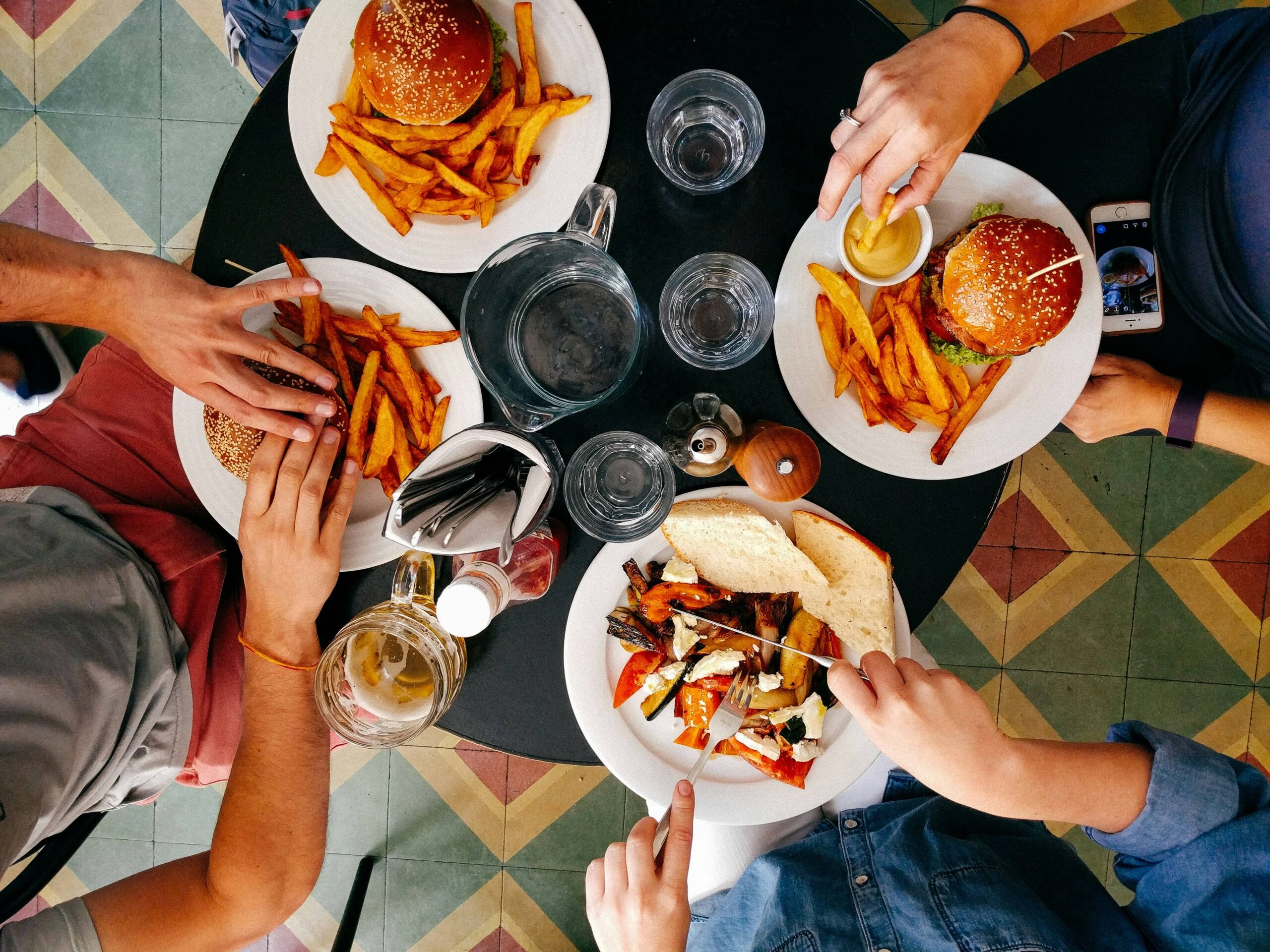
After I was a child, we virtually by no means went out to eat.
There have been instances after we’d all go to McDonald’s as a household. Or we’d earn sufficient BOOK IT! factors so we’d all go to Pizza Hut on a Friday night time.
I additionally, for some purpose, have a really vivid reminiscence of consuming at Lou’s Pizza in Aberdeen, South Dakota, whereas “We Constructed This Metropolis” from Starship was enjoying within the background.
However consuming out was by no means a traditional a part of our household’s life—it was all the time one thing particular.
We didn’t have some huge cash rising up, so I suppose that was an element. However my basic recollection is that consuming out was a comparatively uncommon event for each me and my associates.
Due to the individuality, it was an thrilling expertise every time and one thing to look ahead to. Or it was saved for moments after we had one thing to rejoice.
Now, it doesn’t really feel that manner. It looks as if we’re consuming out much more usually. And the numbers appear to again up my assumption. Restaurant trade gross sales grew sevenfold between the years 1970 and 1995.
Consuming out has develop into an virtually anticipated incidence in our lives at present. Not the exception.
Individuals now eat out roughly 8 instances/month (extra usually than they suppose). Practically 4 in 10 of us get meals delivered not less than as soon as per week. And greater than 50% of adults eat out three or extra instances per week.
I even know households that go to a number of eating places on the identical night time so every particular person can get what they need.
The stats bought me questioning: When did this occur? Why did it occur? And does it matter?
When did this occur?
The “when” isn’t troublesome to determine. We have now the numbers.
In 1968, 33.8% of American meals spending went to consuming out. By 1987, it was 44%. By 2009, we spent more cash consuming out than consuming in. So roughly, for the final 20 years, we’ve been spending more cash consuming out than consuming at house.
In truth, final yr (2025), that quantity had climbed to 56% of whole meals spending.
Why did it occur?
As is usually the case, I’m certain there isn’t any single issue.
However the restaurant trade definitely labored laborious to make it occur by specializing in the identical ideas that permit consumerism to thrive: Affordability, Accessibility, and Promoting.
Regarding affordability, worth menus have been launched within the late Eighties particularly for the aim of getting extra folks to eat out extra usually. Wendy’s was first, in 1989, and most fast-food eating places adopted their lead.
Larger accessibility for consuming out occurred in two methods.
Drive-thrus made consuming out simpler. The primary ones appeared within the late Nineteen Forties, and McDonald’s opened its first in 1975. However innovation and expertise (together with dashboard cup holders in automobiles) ramped up the expertise within the Eighties. So by the late Eighties, drive-thru orders overtook dine-in meals at quick meals eating places. Right now, about 70% of fast-food gross sales come by way of the drive-thru window.
It turns into a lot simpler to eat out after we don’t even must get out of the automotive. However eating places didn’t simply develop into simpler to order from; additionally they grew to become extra ubiquitous.
Between 1972 and 1997, the variety of fast-food eating places per particular person in America doubled.
They usually simply stored constructing them. Over the subsequent fifteen years (2000 – 2015), the variety of quick-service eating places within the U.S. grew by practically 20%, from about 285,000 to greater than 340,000.
They usually have been positioned strategically at busy intersections, close to freeway exits, and alongside the roads we drive to work and faculty day-after-day. A number of places of the identical restaurant have been positioned in even small cities to make them accessible. Eating places went from one thing we drove to, to one thing we drove previous.
And with the rise in affordability and accessibility got here will increase in promoting.
By 1997, eating places have been spending $3.1 billion a yr on promoting—greater than 30 instances what they spent in 1970. Twenty years later, it had greater than doubled once more. Quick-food corporations alone spent $5 billion on promoting in 2019.
Within the late Nineties, the meals trade was the second-largest advertiser within the American economic system.
There are different causes too that this progress occurred: the introduction of kid-sized parts paired with toys (1979), the onset of the superstar chef (early Eighties), popular culture partnerships, Meals Community (1993) birthed a tradition that watches extra cooking than it does, reward factors, and now cellular ordering and entrance door supply.
However the restaurant trade didn’t simply change—we additionally modified.
1. Twin-income households. In 1975, each dad and mom labored full time in 31% of two-parent households. Right now, that quantity is greater than half, 52%. With each dad and mom working, cooking at house turns into tougher and simply grabbing meals on the way in which house turns into a lot simpler.
2. Busier schedules. As expertise blurred the boundary between work life and private life (e-mail will be learn from wherever), it takes extra intention to find time for cooking at house. Add in elevated particular person actions for your complete household (practices, classes, and video games) and discovering dinner time as a household will get more durable.
And make no mistake, the restaurant trade each capitalized on this and made it attainable. Domino’s, for instance, constructed a whole franchise across the philosophy “We don’t simply promote pizza—we promote time.”
3. Much less cooking at house. As fewer folks usually cooked from scratch, cooking expertise and different primary expertise (planning a meal, improvising, realizing how lengthy issues take) waned for a lot of adults, and the subsequent technology didn’t be taught them at house or in class. That made cooking really feel more durable and riskier than it used to, which additional elevated reliance on eating places.
4. Smaller households. In 1960, simply 13% of households have been one particular person. Right now, it’s virtually 30% and single folks outnumber married folks in the US. Cooking for one usually doesn’t really feel definitely worth the effort.
5. Hospitality moved out of the house. We used to ask folks over for dinner. Now we select to fulfill them at a restaurant. The share of Individuals who say they host associates or household at their house not less than month-to-month has fallen from 42 p.c in 1975 to 12 p.c in 2026—a 70 p.c collapse in a half-century.
6. A “we deserve it” mentality. In 1971, McDonald’s instructed us, “You deserve a break at present.” And we believed it. The extra we labored, the longer we labored, and the extra of us in our house who went to work, the extra consuming out grew to become one thing we felt we deserved for our effort. Consuming out wasn’t particular, it was one thing we had earned… on our solution to work, whereas at work, and after work.
However the final of the three beginning questions (When did this occur? Why did it occur? And does it matter?) may matter essentially the most.
What’s the large deal about the place we get our meals or who’s cooking it? That’s a good query. What’s the downside with consuming out?
Properly, there won’t be a difficulty with elevated frequency… assuming we are able to afford it financially and it isn’t coming on the expense of our well being or household relationships. However I’m undecided that’s the case. Let’s dive into the information.
Does it matter?
If every little thing within the present trajectory of our lives have been wonderful, this transformation in how we devour meals wouldn’t be a difficulty. However not every little thing is okay.
Individuals are extra in debt than ever. Individuals owe a document $1.29 trillion on their bank cards and the common bank card steadiness per shopper now stands at $6,678. In the meantime, we’re spending greater than $4,100/yr consuming out, and it prices three to seven instances extra (relying on the meals) to eat out than to eat at house.
We aren’t getting more healthy. Greater than 40% of American adults have weight problems, practically three in 4 are obese, and diet-related ailments at the moment are the main trigger of demise within the U.S. Restaurant meals are inclined to comprise extra energy and fewer vitamin than meals ready at house. And one giant research discovered that individuals who ate out extra regularly had increased charges of most cancers and coronary heart illness, together with a better threat of demise.
{Our relationships} are getting worse. About half of American adults report experiencing loneliness. In the meantime, over the previous three a long time, household time on the dinner desk and household dialog, basically, have declined by greater than 30%. However the household desk is likely one of the most vital and long-lasting elements of kid growth.
Research present that teenagers who eat frequent household dinners usually tend to earn A’s and B’s, much less more likely to expertise despair, and fewer possible to make use of tobacco, alcohol, or medication. And when teenagers have been requested to call the very best a part of household dinners, 71% mentioned speaking, catching up, and spending time with household.
Extra debt. Poorer well being. Much less time cooking collectively and consuming round our personal desk targeted on the relationships our kids want.
In the meantime, we’re selecting to eat out greater than ever. Sure, it issues.
Possibly it’s time we make consuming out particular once more.






Discussion about this post