

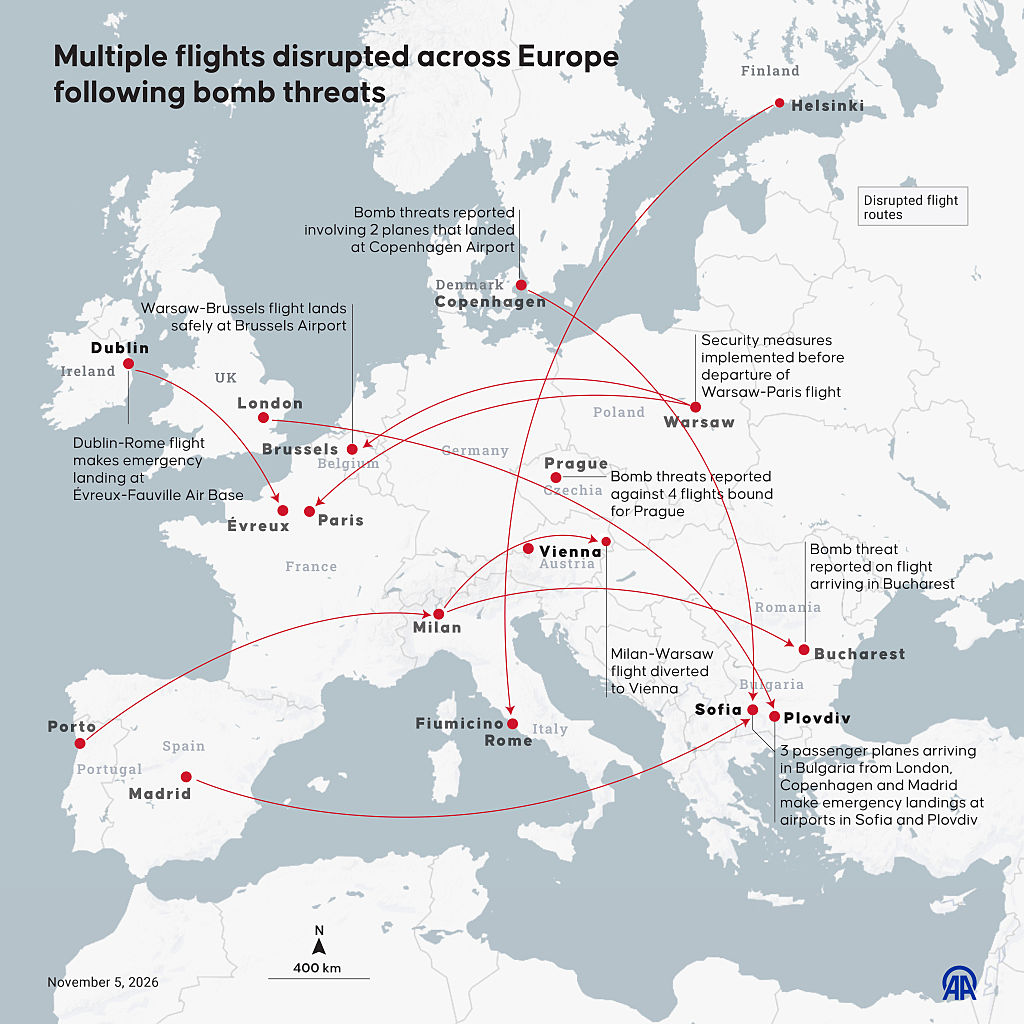
A wave of bomb threats this week focused dozens of flights throughout Europe earlier than increasing to incorporate newsrooms, leaving authorities scrambling to search out these accountable. The bomb threats—all since recognized as hoaxes—got here by nearly day by day through nameless calls and emails starting Nov. 2.
On Monday, a Wizz Air flight touring from London to Bulgaria was diverted after a bomb risk was obtained mid-flight, making an emergency touchdown in Budapest. At the least seven passenger flights had been focused the next day, which led to emergency landings, searches, and diversions. Greater than two dozen extra flights had been focused Thursday, and threats continued into Friday.
Affected flights linked nations together with Italy, Eire, Spain, Bulgaria, Romania, Poland, Finland, Austria, Denmark, Belgium, Portugal, France, Greece, Serbia, Czechia, and the UK.
Authorities, together with the U.Ok. Transport Secretary, have since described them as “hoaxes,” as no assaults had been carried out and every affected flight was landed safely. However the hoaxes weren’t innocent; they affected hundreds of individuals’s flight plans, struck concern into potential vacationers, and impacted the fastidiously structured aviation ecosystem.
The malicious efforts expanded Friday when a warning was despatched by electronic mail to a number of European broadcasters claiming that bombs had been planted of their buildings, forcing evacuations at shops like Sky Information, Bulgaria’s Nova TV, and Irish public broadcaster RTÉ.
“What occurred this week is only a small a part of what awaits Europe within the close to future,” the message despatched to broadcasters stated, in keeping with Reuters.
European Union Transport Commissioner Apostolos Tzitzikostas strongly condemned the threats on X on Friday, saying that he has activated EU-level aviation safety information-sharing mechanisms. He added that it was “too early” to attract conclusions on whether or not the hoaxes had been linked.
Eire’s authorities, in the meantime, stated Friday that “it appears possible that it is a co-ordinated marketing campaign of disruption.”
Consultants inform TIME that the threats themselves is perhaps the purpose—launching a concern marketing campaign meant to disrupt methods and put tens of millions of individuals on edge.
Might the bomb threats be hybrid warfare?
Spanish Overseas Minister José Manuel Albares advised Spanish broadcast information on Friday that the threats had been an “try at hybrid aggression and psychological warfare.”
Elisabeth Braw, a senior fellow on the Atlantic Council, which is a nonpartisan suppose tank for international affairs based mostly in D.C., says that these sorts of threats fall into what she calls “grey zone conflicts,” that means that they’re “within the grey zone between warfare and peace.”
For instance, Italian Prime Minister Giorgia Meloni advised an Italian information station on Friday that “what’s being attacked is civilian infrastructure,” quite than navy or weapons infrastructure. This places European nations in a good spot, Braw says, particularly if the actor is one other nation.
“In case you assault one other nation’s navy, that nation’s navy will strike again. That’s the nature of warfare,” she explains. “Whereas if you happen to goal civilian infrastructure, what’s that nation going to do? It’s not going to reply with navy means, just because then you definitely would have warfare.”
Learn extra: What Does the Iran Struggle Imply for the Menace of Assaults within the U.S.? Right here’s What Consultants Say
Bomb threats in opposition to airliners will not be new, Braw says, however their scale and frequency this week stand out.
“What’s regarding this time is it is such a major quantity, and the truth that these have are available in such shut succession, and it comes in opposition to the background of all these different assaults and actually geopolitically motivated crimes concentrating on European nations,” Braw provides, referencing one other destabilization operation that lately hit Europe.
Cyberattacks focused refrigeration methods at grocery shops in not less than 9 nations throughout Europe and at blood banks in France, following related assaults on French supermarkets in mid-October.
Two pro-Russian hacktivist teams claimed accountability for the cyberattack marketing campaign on supermarkets Wednesday, although their involvement stays unconfirmed.
U.S. federal businesses launched a reality sheet the next day that referred to as on hospitals, transportation methods, and meals retailers to “defend in opposition to this exercise through the use of robust authentication.”
Kremlin Spokesperson Dmitry Peskov distanced the Russian authorities from the cyberattacks on Thursday, calling any allegations “absurd” and “unfounded.”
Robert Jordan, a program director on the Royal United Providers Institute, tells TIME that it is perhaps “tempting” to ascribe the threats to hostile states like Russia.
“Definitely there are well-founded cases of Russian and Iranian teams recruiting individuals on-line utilizing safe communications functions to conduct related exercise,” he says.
On the identical time, he continues, there isn’t a approach but to low cost that that is a person or non-state-affiliated group exploiting security requirements within the area to “trigger chaos.”
Earlier than the events accountable might be ascertained, or their motives investigated, safety personnel should establish the place these threats are originating from, he says.
Till they do, disruptions to airports are more likely to proceed, Jordan says. Even suspected hoaxes demand critical consideration, Braw provides, given the doubtless devastating penalties of an actual assault.
“You must take each risk severely within the sector, however particularly in aviation, the place the implications could be so totally devastating if an incident had been profitable, and in order that’s why we’ve got seen all these airliners making emergency landings,” she says. “All of that causes disruption and it causes anxiousness amongst passengers, and it additionally causes important monetary prices and losses for the airways.”
French prosecutors are investigating whether or not international powers are linked to the bomb threats, Agence France-Presse (AFP) reported Saturday. The aim of the investigation is to search out “the authors of the emails who disseminated this false data … and to find out any potential hyperlinks they might should international powers,” the Paris prosecutor’s workplace is quoted as saying.
Among the emails had been signed “fighters of the Male State,” which matches the title of a radical misogynist group in Russia, although there was no confirmed hyperlink, in keeping with AFP. The group’s founder, Vladislav Pozdniakov, denied any involvement, saying on social media Friday that the “motion doesn’t exist since 2021.”
“Figuring out who’s doing it will quickly be escalating up the precedence ladder for legislation enforcement and safety providers throughout Europe,” Jordan says. “Within the meantime, it’s possible that airways and airports will probably be assembly to find out how a lot further screening scrutiny the system can bear.”
Even after studying who made the bomb threats, European nations won’t be any nearer to realizing how to answer related hybrid assaults sooner or later, Braw says.
“As a law-abiding democracy, you possibly can’t say, ‘Properly, in the event that they threaten our airways, we are going to threaten them.’ That’s not how democracies function,” Braw says. “But you possibly can’t enable these kinds of actions to proceed to proliferate, and that may be a dilemma for European governments each single day nowadays.”
The dilemma is changing into an increasing number of “acute,” she provides, because the threats speed up and develop extra refined.






Discussion about this post